Everybody looks forward to Thanksgiving, but the day itself is mostly about looking back. It’s an opportunity to give thanks for the harvest we’ve just finished.
Americans spend much of the fall in anticipation of the holiday. For them, arrives on the fourth Thursday of the eleventh month, which this year is on November 26. Here in Canada, Thanksgiving is on the second Monday of the tenth month—so for us, it was six weeks ago, on October 12.
The dates are different, but the tradition of harvest celebrations is shared. And we share it with the world. People outside North America know Thanksgiving by different names, such as the yam festivals of Nigeria to Erntedankfest in Germany.
There’s something deeply human about taking a crop, hoping for abundance, and expressing thanks. It might be for the gift of a divine being, the blind forces of Mother Nature, or both. Whatever the source, we’re grateful.
This year, I’m grateful for the conclusion of a challenging season. The rains started in Saskatchewan in August and they poured into September. It was one of the wettest harvests I’ve ever witnessed as we brought in durum wheat that becomes pasta, canola that becomes vegetable oil, and lentils that become food in stews, soups, and salads around the world.
It was a muddy and miserable slog.
The last crop to come in was the flax, which we finished right before Canada’s Thanksgiving. A big part of me is grateful simply because we got the job done and nobody got hurt.
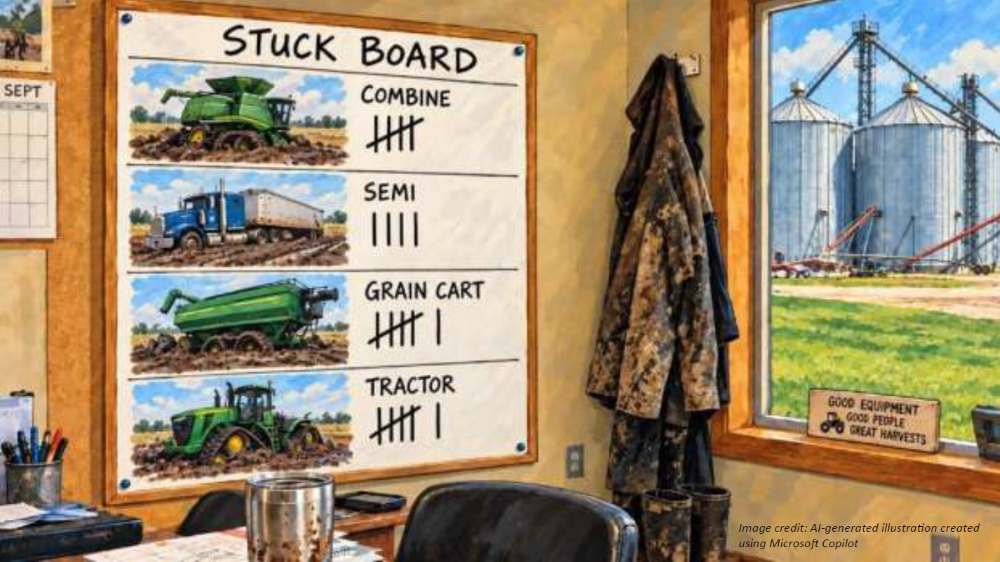
There were some hurt feelings, though. In our farm’s office, we maintain the “stuck board.” It’s best understood as a “wall of shame” for everyone. If you’re handling one of these big machines, whether a combine, a grain cart, or even a semi, and get stuck in the mud so badly that you need help getting out, then your name goes on the stuck board.
Nobody wants to go on the stuck board.
This year there was a lot of getting stuck. The stuck board overflowed with names and incidents. The rain-drenched fields made it inevitable. Yet good drivers can avoid the frustration and embarrassment by relying on skill, wisdom, and experience. My father, for example, knows our farm better than anybody. He’s aware of all the tricky spots. He rarely makes mistakes.
The stuck board is our modest effort to lighten the mood and poke fun at ourselves. It also has a competitive purpose. And while I will neither confirm nor deny that my name appeared on the stuck board this year, I will happily report that my dad was listed. This made it impossible for him to spend Thanksgiving telling the family about his perfect performance in tough conditions.
You have no idea how much this fills me with gratitude.
The harvest itself was so-so. We didn’t a enjoy a boom year, but at least we didn’t suffer from a bust. Our top fields produced an average yield. Many were poor. Like farmers everywhere, we paid a high price for fertilizer and fuel. These costs cut into our bottom line. We’ll probably break even.
Farming has taught me more than I ever wanted to know about resilience. You can work hard and do everything right and still not get the result that you think you deserve. It means that sometimes breaking even is good enough—and that we should be grateful for the break-even years as much as the bountiful ones.
Harvest is over, but the work never stops. Even as our days darken, we’re preparing for the next growing season. We’re hauling grain. We’re cleaning and fixing machinery. We’re draining pumps. We’re applying fertilizer and herbicides, cleaning up what we can of 2026’s mess, and moving earth. We’re reviewing budgets. We’re going to conferences and trade shows to learn about new technologies and methods.
Before long, spring will return. One of our first tasks in 2027 will be to clean up the ruts of 2026. We prefer to complete this chore in the fall, but first our wet fields must dry.
When we’ll be back outdoors and in our fields, I’ll feel grateful for the chance to farm all over again.
Image credit: Farm office scene AI-generated using Microsoft Copilot