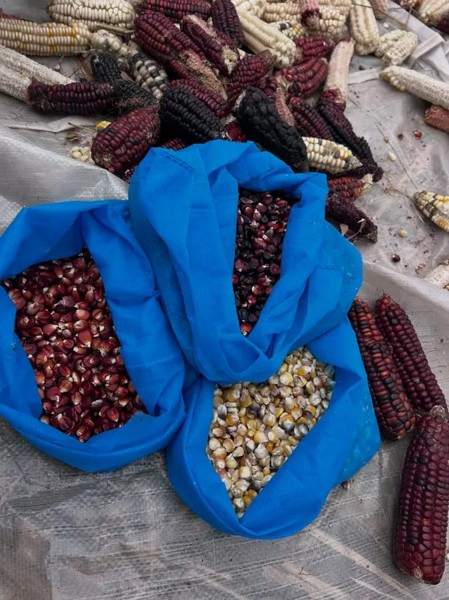
It started, as so many good conversations do, with a photograph. A member from Malawi Blessing Malefula dropped a picture into our Global Farmer Network Africa WhatsApp group sacks bursting with maroon, black, and speckled kernels, cobs in every shade but the familiar white and yellow and asked a simple question: does anyone else still grow seed like this?
What followed was one of those threads that reminds you why farmer-to-farmer conversation matters more than any policy brief. In a few hours, farmers from South Africa, Kenya, Ghana, Mali, Nigeria and Malawi turned one photo into a continent-wide conversation about seed, culture, markets, and what it really means to farm “as a business.”
The Seed Is There. The Market Isn’t.
Motlatsi Musi, farming in South Africa, confirmed the colored varieties are still around kept alive largely by seed-saving, organic-leaning farmers. But he was quick to push back on a claim sometimes made about these old varieties: that they simply out-yield modern seed. “It’s just a point of argument creation,” he said, “what they’re telling you.”
Lucy Kaari, farming in Kenya, put it more bluntly: her family has stopped growing colored maize altogether. Not because it doesn’t grow well, but because it doesn’t sell. “Many farmers produce white maize for selling,” she explained. “This colored maize has no market.” Amadou Sidibe, farming in Mali, described a similar but distinct pattern on the other side of the continent: white maize barely moves there either, because his main buyers are poultry and egg producers who need the yellow pigment that gives egg yolks their color.
It was Musi who named the fault line running through the whole discussion: colored and brown maize, he said, have become the domain of “emerging farmers and the environmentalists not for business.” Amadou agreed from his own vantage point, noting that roughly 80% of his harvest already goes into poultry feed rather than the plate.
A Grandparent’s Crop, A Grandchild’s Business
For Lucy, the shift was generational as much as commercial. Colored maize, she recalled, was what her grandparents planted. “Now we do farm as a business we can’t even imagine planting these seeds.” It’s a sentence that captures, in one line, the quiet trade-off many African farmers have made over the past two generations: heritage varieties adapted to local soils and diets, exchanged for the market certainty of white or yellow maize.
A Malawian voice pushed back gently on the group, asking whether colored maize could ever “win the hearts of people” the way white maize has if farmers told its story and its benefits more loudly. It’s a fair question, and one the group didn’t fully resolve. But it hints at an opportunity: nutrition-dense, colorful heirloom grains are having a moment in global food conversations. Whether that translates into local market demand in Lilongwe or Nairobi is a different matter entirely and one worth researching properly, rather than assuming.
One Continent, Several Staple Foods
The thread also surfaced something GFN members don’t always get to see side by side: just how differently maize is used across the continent. Amadou reminded the group that while maize anchors diets across Southern Africa, West Africa leans more heavily on rice and millet. Patience Koku, joining from Nigeria, described how maize still shows up widely in the north of her country, while the South and East eat it as a breakfast pap “akamu” and elsewhere it’s swallowed alongside relish, much as in South Africa. Musi confirmed the South African pattern plainly: white maize is the staple for people, yellow maize goes to animal feed.
Machines, Grain, and a Little Bit of Humor
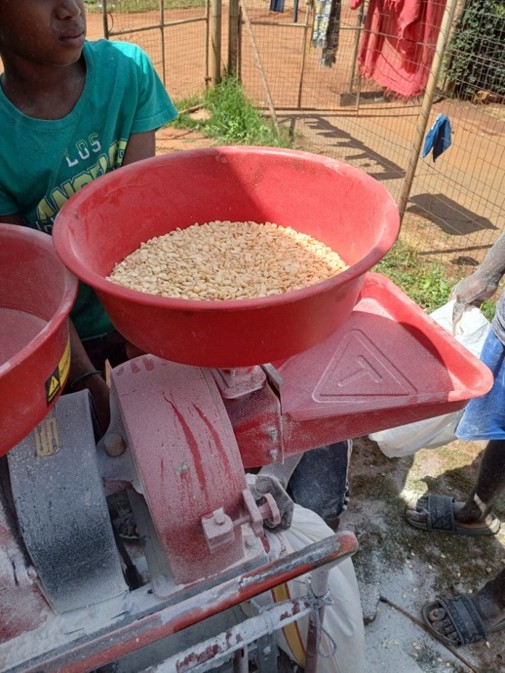
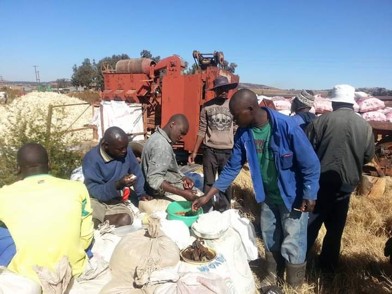
Alongside the seed-and-market debate, the group traded notes on processing too. Patience described smaller, more efficient threshers that are easier to manage and deliver more tons than the larger rigs some are used to, and mentioned lining the threshing floor with tarpaulin to reduce grain loss to wind. Amadou noted his own maize and grain, by contrast, is destined mostly for poultry and livestock feed rather than milling for people.
And because farmers are farmers everywhere, the conversation ended the way good farm banter often does with a joke about the other creatures who also love a maize harvest. “Food production is like a battlefield,” Musi commented, “some soldiers don’t come back alive.” He was talking about the doves that raid his fields and admitted the traps he sets for them do double duty, supplying the occasional lunch of pigeon and white maize porridge, a meal he remembered fondly from years past.
Why This Conversation Matters
No policy was written in this thread. No report was published. But in under an hour, farmers on five different points of the map compared notes on seed diversity, market access, generational change, and food culture the exact kind of knowledge exchange the Global Farmer Network exists to enable. It’s a reminder that behind every debate about seed systems and market access are farmers making real, often difficult trade-offs between what their grandparents grew and what pays the bills today.
Compiled from a discussion among Global Farmer Network Africa members on WhatsApp, featuring contributors from Malawi, South Africa, Kenya, Ghana, Mali, and Nigeria.
Report by – Patience Koku, Nigeria, Global Farmer Network Regional Lead: Africa Ag and Ruramiso Mashumba, Zimbabwe, Global Farmer Network Regional Lead: Africa Ag
To learn more, contact Mary Boote, +1 515.274.0800 or [email protected]