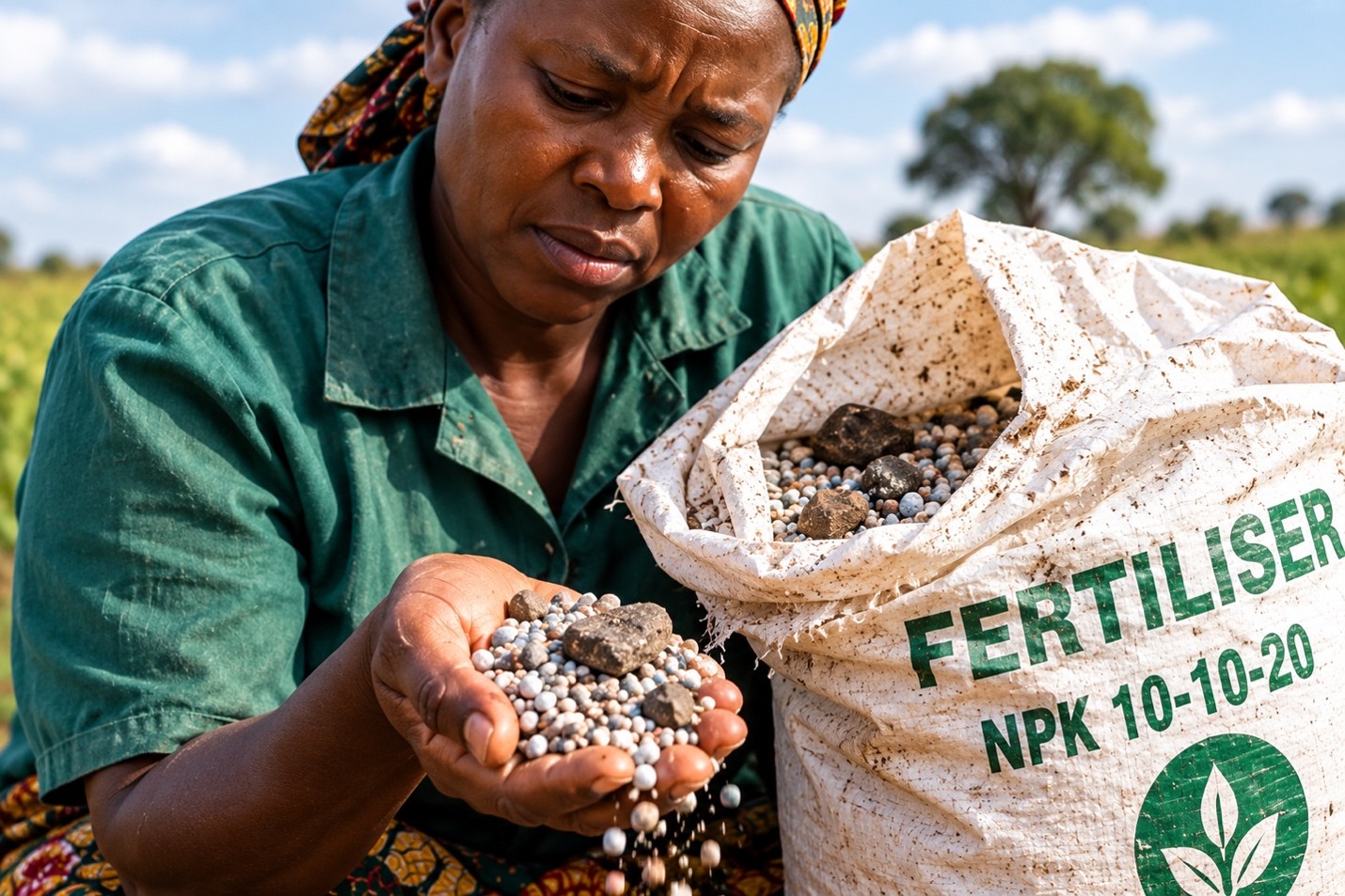
When a smallholder farmer in Zimbabwe hands over her hard-earned savings for a bag of fertilizer, she is trusting that what’s inside will feed her crop not damage it. Too often, that trust is misplaced.
I work alongside women smallholder farmers in Mashonaland East Province, helping them build climate resilience through conservation agriculture. Part of that work involves logistics getting the right inputs into the right hands at the right time. It was through this hands-on logistics work that we stumbled onto a problem far bigger than we expected.
While sorting and transporting fertilizer for farmers, our team discovered something alarming: bags contaminated with stones in some cases, three to four stones per bag. These weren’t just impurities. They were physical hazards that damaged planting equipment, jamming and breaking planters designed for uniform, flowing fertilizer granules. For a farmer operating on thin margins, a damaged planter is not a minor inconvenience. It’s a lost planting window, an unplanned repair bill, and in a bad season, the difference between a harvest and a failure.
The fertilizer problem is only one thread of a much larger issue: the proliferation of counterfeit and unverified agricultural inputs sold through unregistered dealers across rural Zimbabwe and, we suspect, much of the African smallholder farming landscape. Farmers, often without easy access to registered agro-dealers, buy what’s available and affordable nearby. Unregistered dealers fill that gap, but frequently with products that are adulterated, mislabeled, or entirely counterfeit.
Fertilizer is not the only casualty of this gap. Through farmer interviews conducted as part of our fieldwork, we heard troubling accounts of farmers who suffered chemical burns from agrochemicals a direct result of unclear labeling, missing usage instructions, or products that simply weren’t what they claimed to be. These are not isolated incidents. They point to a systemic gap in how verified, safe agricultural inputs reach the farmers who need them most.
There is also a quieter, more insidious version of this problem: seed and cultivar misuse. We regularly hear farmers say that a particular maize or vegetable variety “doesn’t work” that yields were poor, or the crop failed to perform as expected. In many cases, the seed itself was genuine. The real issue was incorrect use: planting a cultivar suited to a different rainfall pattern, soil type, or agroecological zone, without the technical guidance to match variety to conditions. When farmers lose confidence in a legitimate cultivar because of a mismatch they didn’t know to avoid, it doesn’t just cost them a season it erodes trust in improved varieties altogether, pushing farmers back toward lower-yielding, less resilient options.
Taken together, these three problems contaminated fertilizer, unsafe or counterfeit chemicals, and cultivar misuse share a common root: farmers lack reliable access to verified inputs and the knowledge to use them correctly. This is not a failure of farmers. It is a failure of the systems meant to protect them.
What needs to change
First, we need stronger enforcement against unregistered agro-dealers, paired with expanded access to registered, verified suppliers in rural areas where the nearest legitimate dealer may be hours away. Proximity to a legitimate source is often the single biggest factor determining whether a farmer buys genuine or counterfeit inputs.
Second, input verification needs to happen closer to the farmer through community-level checks, farmer education on what genuine products look like, and partnerships between organizations like ours and agricultural extension services. Government extension officers and institutions like Marondera University of Agricultural Sciences and Technology have a critical role to play here, and collaboration between grassroots organizations and technical bodies is essential.
Third, cultivar guidance must travel with the seed. Farmers need not just access to improved varieties, but clear, localized guidance on which cultivar suits which conditions delivered through trusted channels like community champions and peer farmer networks, not just a label on a packet.
At Mnandi Africa we’ve built our model around right-sized inputs matched to farmer needs and preferred varieties an approach that also gives us a front-row seat to problems like these. What we’ve found should concern every organization, funder, and policymaker working in African agriculture: the fight for food security and climate resilience cannot be won if the inputs farmers rely on are compromised before they ever reach the field.
Counterfeit and unverified inputs are a quiet crisis. They don’t make headlines the way drought or flooding does. But for the farmer whose planter breaks mid-season, whose skin bears a chemical burn, or whose harvest fails because of a cultivar mismatch no one warned her about, the damage is just as real and just as devastating.
It’s time we treated input verification as seriously as we treat seed innovation and climate adaptation. Because none of it matters if what’s in the bag isn’t what it claims to be.