Public radio in Nigeria marked a milestone with its 75th birthday this year. Rather than celebrate, however, Radio Nigeria put out a press release that doubted its own significance: “Can public radio remain relevant in an era defined by digital disruption?”
It’s a fair question in a world of media choices on our phones, televisions, and computers. Radio can feel very old-fashioned and perhaps in terminal decline, like an audio version of printed newspapers and magazines.
I’m pleased to report that the rumors of radio’s death are greatly exaggerated.
Radio remains a durable and essential form of communication, especially for farmers in Africa. I know this from experience: As a Nigerian farmer, I turn to radio for news, information, and entertainment. I know many other farmers who use it a lot more than I do.
That’s why I’m involved with a group that produces a weekly show about agriculture for a rural audience in northern Nigeria—and why we’re seeking to expand our services soon.
Radio flourishes in Nigeria as “the most consumed and accessible medium,” according to the Food and Agriculture Organization of the United Nations. It plays “a critical role in information dissemination across a linguistically and geographically diverse population, particularly in rural areas where it often remains the only reliable source of information.”
The data are compelling. More than 80 percent of Nigerians listen to the radio each week. More than half of all households own a radio receiver. And even among internet users, more than a third tune into radio streaming services.
This reliance on radio is strongest in rural areas, where cellular service is often spotty and sometimes nonexistent. What’s more, digital literary is lower in these regions, especially among older people. They use radio because they know it and like it.
Yet radio everywhere still struggles with what the analytics company Nielsen calls a “perception gap”—the suspicion that it’s ineffective, despite the fact that “it actually delivers some of the highest [return on investment] globally.” Even in a wealthy nation such as the United States, where people can take advantage of the most advanced communications technologies, “radio continues to reach more American consumers than any other platform, linear or digital,” according to Nielson.
In a column last year, Global Farmer Network co-founder Bill Horan described how radio remains an excellent way to amplify the voices of farmers. “We are content providers who have great stories to tell,” he wrote.
Competing forms of media simply can’t match radio’s advantages. Radio can deliver live and local reports about news and weather. It’s uniquely suited to farmers who listen while they drive tractors and trucks. Its signal is dependable. It’s especially dependable in a crisis, when internet and cellular services are more vulnerable to interruptions and failures. Its spoken-word format carries an intimacy that nothing else can match.
Best of all, it’s free to anyone with a receiver.
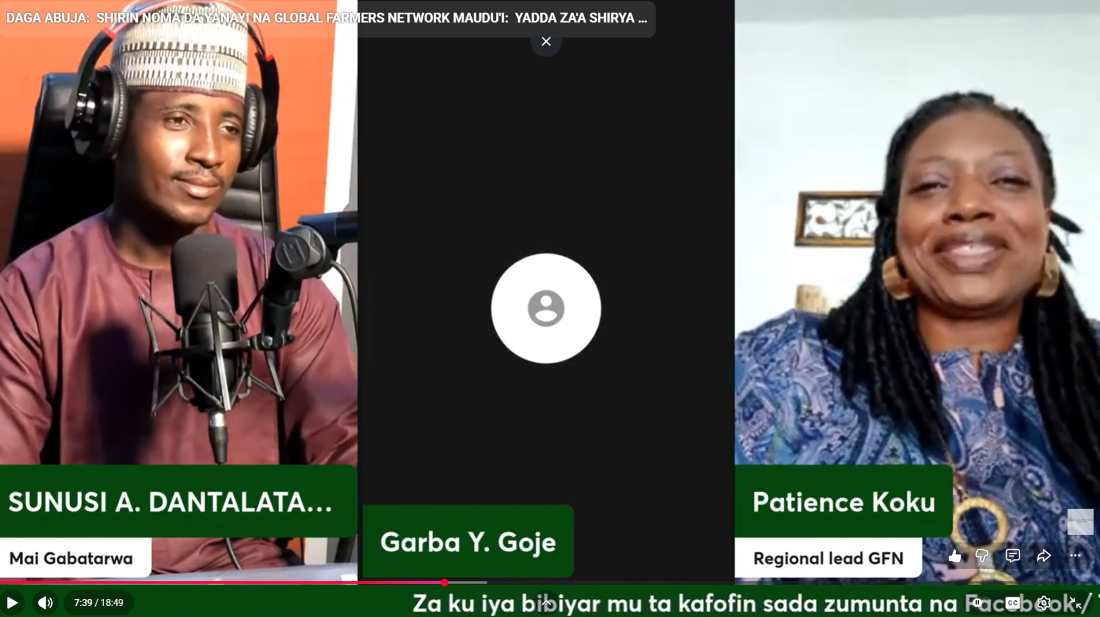
This is why I’ve become involved with a weekly radio show for farmers. Every Monday at 11 a.m., we provide programming with a purpose. Our mission is to improve Nigerian agriculture by letting farmers talk to other farmers. Our hosts discuss tips and techniques. Listeners call in and offer their views. This is knowledge transfer in action, as we get the message out about best practices: Why no-till methods are often better than plowing, why it’s better to buy new seeds rather than save old ones, and how to cope with the challenges of climate change.
Our FM signal originates from a tower in the northern city of Kano. We expand our reach by putting the show on YouTube and Facebook. We broadcast in Hausa, a language spoken by more than 90 million people in northern Nigeria and throughout West Africa. Soon we’ll add English subtitles for listeners who join us by social media. In 2027, we will seek to launch a program in English, which is widely spoken in Nigeria, especially as a second language.
Asking whether radio can compete with 21st-century media may have it backward. The real question, especially for farmers, is whether other media can compete with the good old radio.