They called my father crazy.
That was half a century ago. Today he’s widely regarded as one of the world’s great agricultural innovators because he’s a founding father of no-till farming in Brazil—and this month marks the 50th anniversary of his pioneering effort to revolutionize crop production in our country.
The story starts shortly after World War II, when my grandfather left the Netherlands and moved to Brazil. In 1947, he traveled across the ocean with 40 heifers and a bull. About a decade later, he owned his own dairy farm on the land we continue to cultivate today. It’s an area of low fertility: a natural grassland with sandy soils, steep slopes, and torrential rains.
These were the perfect ingredients for a disaster of degradation—a crisis of conservation waiting to happen.
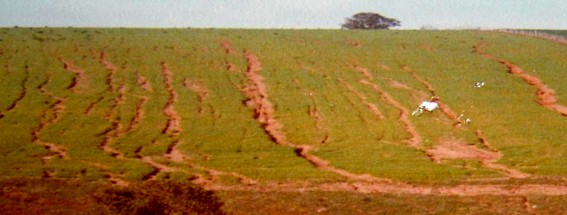 Erosion problems before no-tillage.
As the family dairy farm began to introduce crops—rice and corn in the 1960s, then soybeans and wheat in the 1970s—my father spotted the problem. The soil was washing away. It got worse every year. Something had to change.
Around this time, my father visited the United States and met Shirley H. Phillips, an agronomist at the University of Kentucky. Phillips was researching ways for farmers to lower their fuel consumption, due to the era’s oil crisis. One way was to cut back on plowing. Phillips saw that when farmers kept their plowing to a minimum, they not only burned less gas in their tractors but also that their soil stayed in place, improved its health, and nourished crops.
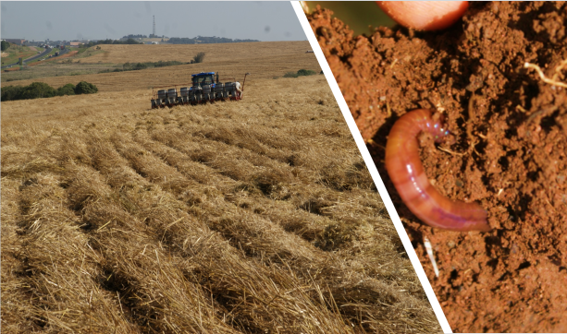
Phillips became a major advocate of no-till farming, a system in which farmers leave straw on their fields following a harvest. Then they use planters that have been adapted to cut through the straw and put the seeds of the next crop directly into the ground, without disturbing the dirt by plowing.
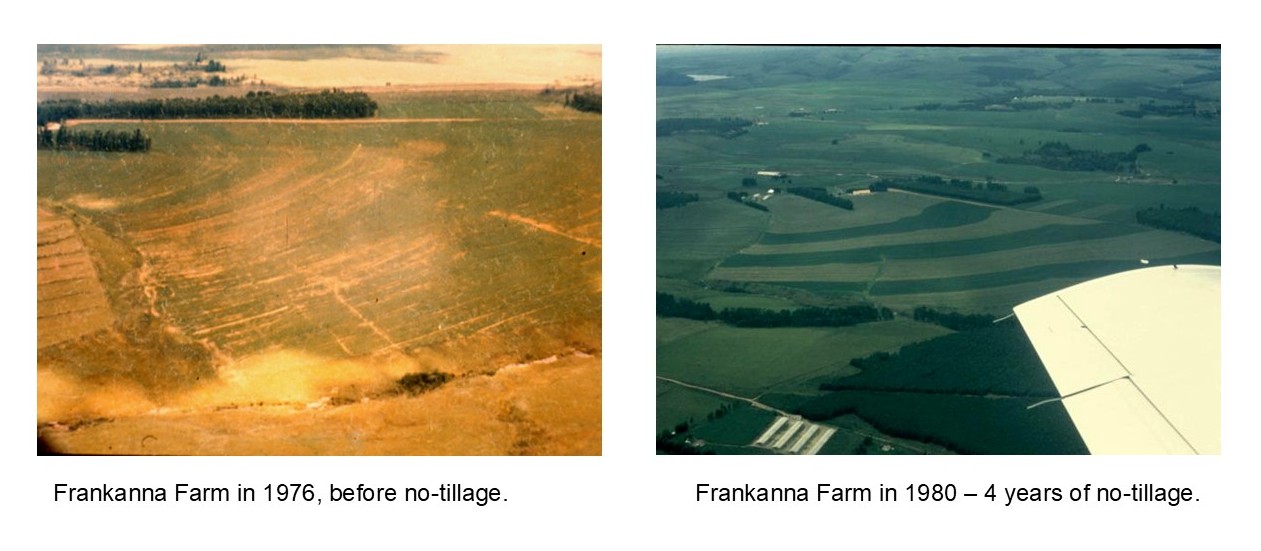
My father decided to try no-till for himself. Fifty years ago on six hectares, he conducted his own experiment. He was so pleased with the results that the next year he turned the entire farm into a no-till operation.
That’s when people said he was crazy. They thought that he put his whole business at risk. He even lost his financial credit because the bosses at his cooperative feared that he would go bankrupt.
This led him to apply for a new line of credit at a different bank. Waiting in the lobby, he met another farmer, Manuel Henrique Pereira, who also was trying no-till. Their encounter was an amazing coincidence, and it led to a partnership of several farmers and researchers. As they exchanged ideas and shared knowledge, they created the future of Brazilian agriculture.
No-till transformed Brazil. We went from being an importer of food to the agricultural powerhouse that it is today: the world’s largest exporter of corn and soybeans.
At the heart of this success is no-till and the way it enriches the soil. About 35 million hectares in Brazil now rely on a system of no-till and crop rotation.
Our family farm is a case study. After my father introduced no-till, we went from losing soil to protecting it. Soon we were making it better.
In our region, the natural level of organic material in the soil is about 3.5 percent. On our farm, however, it’s often twice this rate. In some places, it’s as high as 10 percent. We’re building our carbon levels rather than letting them vanish through erosion.
The results that matter most, of course, is production—and our yields have boomed. We’re growing more food than ever before.
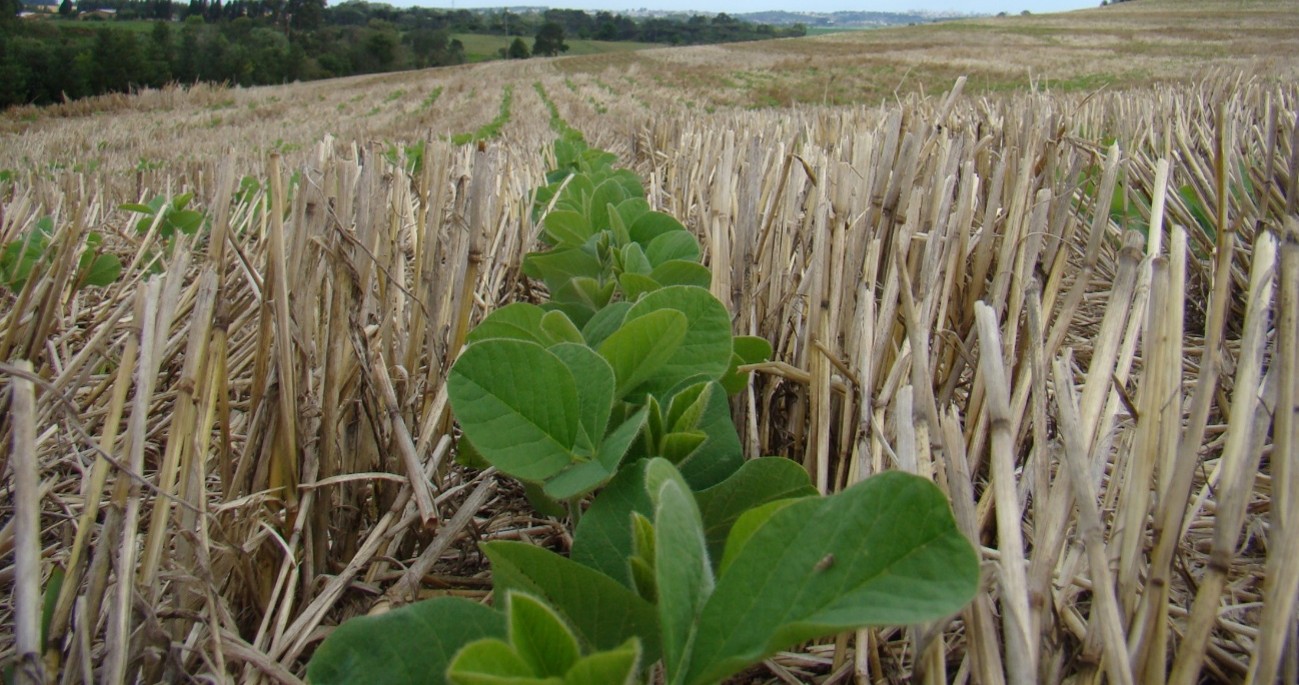 The system on its own would not have achieved the results it did without crop rotation using cover crops.
This achievement has many sources, such as the introduction and flourishing of GM crops, easy access to additional technologies, and the ability to trade commodities across borders.
Yet crops are only as good as the soil that supports them, and no-till agriculture is now the solid foundation of Brazilian farming.
My father tells the story of no-till in a new book, “The Soil Taught Us.” It’s available in Portuguese and English. Yet you can’t buy it in bookstores or online. To get a copy, you must come here, to our farm, Frankanaa—the place where he launched the no-till revolution. Consider yourself invited to see the power of no-till for yourself.