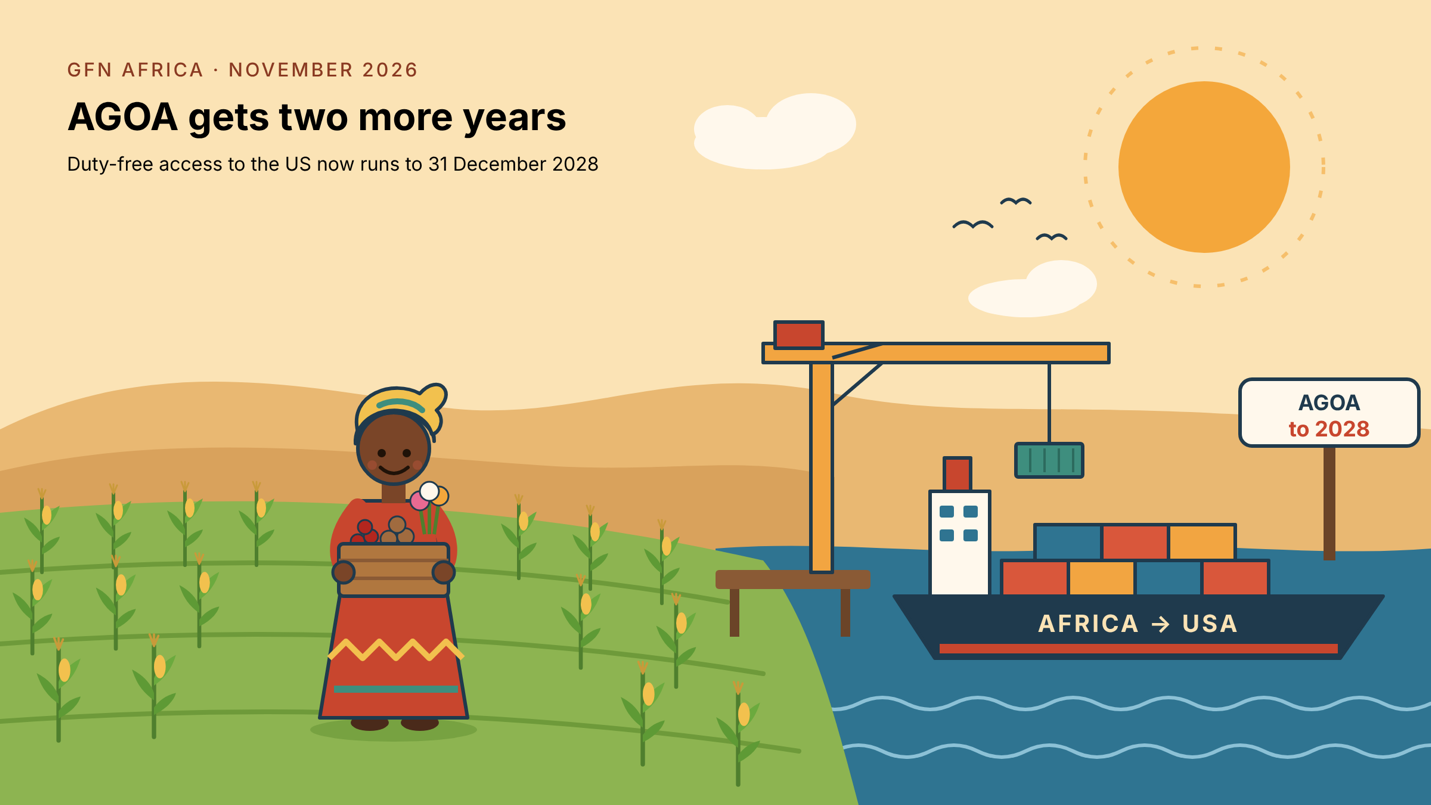
For most of the past year, African exporters have been living on a calendar. The African Growth and Opportunity Act (AGOA), which gives eligible sub-Saharan African countries duty-free access to the US market for thousands of products, lapsed on 30 September 2025. In February 2026 Congress brought it back, but only until 31 December 2026.
That deadline is now gone. In early September 2026, President Trump signed a two-year extension that keeps AGOA alive until 31 December 2028. The House passed it 370 to 48 after the Senate approved it in August. For the farmers, packhouses and factories that sell to the United States, this is welcome news. It is also a reminder that trade built on short renewals is trade built on uncertainty.
What has changed
| Date | What happened |
|---|---|
| 2 Nov 2026 | US announces intent to remove South Africa and Rwanda from AGOA from 1 January 2027 |
| Early Sep 2026 | President signs two-year extension to 31 December 2028 |
| 1 Sep 2026 | House passes the extension, 370 to 48 |
| Jun 2026 | USTR opens the annual review of country eligibility for 2027 |
| Feb 2026 | Congress restores AGOA, retroactively, through 31 December 2026 |
| 30 Sep 2025 | AGOA lapses |
The duty-free access continues. The extension keeps AGOA's existing framework, eligibility rules and product coverage. Exporters can claim refunds on eligible duties paid during the gap after September 2025, through US Customs and Border Protection.
The third-country fabric rule stays. Garment makers can still import yarn and fabric from outside Africa, finish the clothing locally and export it duty-free. This matters for jobs: in Kenya alone, apparel factories employ more than 66,000 people.
Eligibility is now the big risk. The President still decides each year which countries qualify. On 2 November, the US Trade Representative announced the intent to remove South Africa and Rwanda from 1 January 2027. The reasons given included barriers to US trade and investment and national security and foreign policy concerns. South Africa was also cited for corruption, and Rwanda for human rights, rule of law and worker rights. South Africa's Trade Minister Parks Tau called the decision "unfortunate" and said the country will keep diversifying its export markets.
Other US tariffs still bite. AGOA's duty-free treatment does not protect every product. South African vehicles, steel and aluminium, for example, face separate 25% Section 232 tariffs. The new law also allows extra duties on countries found deficient in preventing forced labour in their supply chains.
What it means for African farmers
AGOA is often discussed as a deal for cars and clothing, but agriculture sits right inside it. Kenyan cut flowers, coffee, tea and macadamia nuts all reach US shelves with AGOA's help. In 2025, US imports from AGOA-eligible countries were worth $31.2 billion, and $5.2 billion of that entered under AGOA preferences. That second number is the one to watch: most eligible trade still does not use the program.
For farmers, the two-year extension means:
- Buyers can plan again. Importers sign contracts for whole seasons. A deadline three months away made many hold back. A 2028 end date gives at least two more planting and harvest cycles of certainty.
- Money owed may come back. Exporters who paid duties during the lapse can apply for refunds. Farmer cooperatives and the packhouses that buy from them should check whether they are owed money.
- Eligibility can change overnight. The South Africa and Rwanda decisions show that political and trade disputes far from the farm can close a market. Farmers who supply exporters in those two countries may feel it from January.
- Two years is still short. Building an orchard, a cold chain or a certified packhouse takes longer than two years to pay back. Investors want 10 to 15 years of certainty, not 24 months.
Not every African country is in AGOA. My own country, Zimbabwe, is not part of it. Our biggest farm export, tobacco, is bought by international leaf buyers such as British American Tobacco and trades on ordinary terms, with no AGOA preference.
Whether a country is in AGOA or not, the lesson for farmers is the same: market access can be decided far from the farm, so every farmer needs more than one market.
What farmers and governments can do now
Two years is a window, not a guarantee. Here is how to use it.
Farmers and cooperatives
- Ask your buyer or exporter whether your produce enters the US under AGOA, and whether duties paid since October 2025 can be refunded.
- Use the window to meet US standards: food safety certification, traceability records and pesticide residue limits are what keep the door open.
- Do not put all your eggs in one basket. Look at regional markets under the African Continental Free Trade Area as well as the US.
Governments
- Treat AGOA eligibility as a farm issue. Trade and diplomatic disputes can cost farmers a market they spent years building.
- Help exporters claim their refunds quickly and make the most of the products already covered.
- Start now on a longer-term trade arrangement with the US, so 2028 does not become another cliff edge.
Farmers plan in seasons and invest in decades. Trade policy that renews in short bursts leaves them guessing. AGOA's extension buys African agriculture time. Farmers and governments now need to turn that time into lasting trade, and keep pushing Washington for a renewal long enough to invest against.
Ruramiso Mashumba is a farmer in Marondera, Zimbabwe, and Africa Regional Lead for the Global Farmer Network. To learn more about the GFN's efforts in Africa, contact Mary Boote, CEO.
Sources
- USTR: Ambassador Greer statement on intent to terminate Rwanda and South Africa from AGOA (2 November 2026)
- Ecofin Agency: US Congress extends AGOA through 2028 (3 September 2026)
- Business Day: Trump signs two-year AGOA deal (4 September 2026)
- The Star (Kenya): Trump signs AGOA extension, hands Kenya exporters lifeline to 2028 (5 September 2026)
- Wansom: US lawmakers extend AGOA, new forced labour tariffs (3 September 2026)
- GBC Ghana: US to remove South Africa, Rwanda from AGOA in 2027 (3 November 2026)